

Publicis vs The Trade Desk: What CMOs Must Do Now
Why this Publicis vs The Trade Desk clash matters now
For CMOs and procurement leaders, the Publicis Trade Desk audit is a wake‑up call to take direct control of DSP contracts, fees and audit rights. Treat it as a chance to quantify exposure, close governance gaps, and convert non‑working programmatic spend back into working media value.
Publicis has told clients it can no longer recommend The Trade Desk after an independent fee audit raised three serious red flags: incorrect fee application on gross rather than net spend, added tools without explicit client consent, and limited transparency on detailed money flows, as reported by Adweek. The Trade Desk disputes that it failed the audit, citing confidentiality constraints.
Whichever side you believe, the bigger issue is structural. Programmatic remains painfully inefficient. ANA studies show that only about 36 cents of every dollar entering a DSP typically reaches a consumer as a real impression, with roughly 29 percent lost to transaction costs and 35 percent to non‑productive media effects such as non‑viewable or invalid impressions and made‑for‑advertising sites, according to the ANA Programmatic Media Supply Chain Transparency Study.
For CMOs and marketing procurement directors, this episode is not industry gossip. It is an opportunity to reset digital governance, tighten contracts, and signal to agencies and platforms that you intend to actively manage every step of the supply chain, not passively trust it.
The ID Comms Breakdown
Whats going on?
In this #MediaSnack Live episode, Tom Denford and David Indo unpack why Publicis and The Trade Desk have fallen out so publicly. Publicis commissioned an independent auditor, FirmDecisions, to review how Trade Desk fees were being applied across clients buying through the Publicis master services agreement.
According to reporting from Adweek and Reuters, the audit alleged three core issues: double‑dipping of fees on gross rather than net media, auto‑enrolling spend into tools without clear opt‑in, and insufficient access to granular pricing data for the auditor. Publicis concluded that The Trade Desk did not meet its transparency expectations and advised clients to move their spend.
This comes on top of earlier concerns when WPP and Dentsu quietly backed away from The Trade Desk's OpenPath product, which allowed advertisers to connect directly with publishers. To many holding companies, that looked like a path that could disintermediate agencies from the value chain.
What are the implications?
For advertisers, the noise is not about picking a side in a feud. The implications are about control, exposure, and opportunity cost. If a top holding company cannot get clarity on fee mechanics from a transparency‑positioned DSP, what chance does a single brand have without strong governance in place?
Studies from the ANA suggest that globally around 50 to 60 percent of programmatic budgets never reach the consumer as quality impressions, with a recent benchmark estimating a 26.8 billion dollar global optimization gap in 2025 alone, as summarized by Fiducia. That is the backdrop to this story.
So the practical implication is simple: there is likely significant non‑working or poorly working spend locked up in opaque DSP and supply path fees. If you sit still, that money continues to leak away. If you lean in now, you can identify exposure, renegotiate terms, and reallocate budget into better governed channels and partners.
How should marketers be thinking?
Tom Denford and David Indo come back to one core principle: the golden rule that whoever holds the gold makes the rules. CMOs, procurement directors, and global heads of media control the budgets that keep the ecosystem alive. This is the moment to use that leverage.
Marketers should see the Publicis vs The Trade Desk story as a catalyst rather than a crisis. You do not need to panic, but you cannot be passive. Treat it as a trigger to review every DSP relationship, whether contracted directly or via your agency, and to clarify who has the right to audit, who can add new tools or fees, and how quickly you can exit if expectations are not met.
The healthiest response is not drama, it is disciplined governance. Build a roadmap to bring core contracts in‑house, supported by expert advisors like ID Comms, while still letting your agencies execute on the tools. Your job is to own the rules of engagement, not the keyboard.
Five practical actions for CMOs and procurement
The episode lays out a clear, sequential playbook for CMOs, procurement and media directors who want to respond decisively but calmly.
- Quantify your exposure to The Trade Desk and other DSPs. Start with a 12 to 18 month lookback. How much spend flowed through each DSP and what total fee load did you pay at each layer? Ask for as close to log‑level data as you can get, not just summary invoices.
- Review every DSP contract and audit clause. Check whether audit rights are modern, relevant and truly enforceable. Do you have an automatic right to audit fee structures, data costs and tool add‑ons, and does that right sit with you directly rather than only with your agency?
- Understand the operational impact of changing platforms. If you are a Publicis client, what happens to biddable media delivery if Trade Desk is removed from your plan? Where can spend move without hurting reach, frequency or performance?
- Map the full path of the money, demand and supply. Do not stop at the DSP. Follow your dollars through SSPs, exchanges, verification vendors and intermediaries. The ANA's transparency work shows that transaction costs and media productivity losses together can swallow more than half of your budget. Treat this as an enterprise risk, not just a media problem.
- Plan to bring critical contracts in‑house. Over time, move master services agreements with major platforms from your agency's paper to your own, while retaining agency support on activation. That shift alone changes the power dynamic and makes it much easier to insist on clear, enforceable transparency rules.
Handled well, this is not just defensive housekeeping. It is a chance to unlock budget. Even redirecting 5 to 10 percent of non‑working programmatic spend into high quality media can create a real competitive advantage in market.
Frequently Asked Questions
Q1. Does this mean I should instantly stop using The Trade Desk?
Not necessarily. First, understand your own exposure, then assess whether your contracts and audit rights are fit for purpose. Act on your data, not just headlines.
Q2. How much of my programmatic budget is likely wasted?
Industry benchmarks from the ANA suggest that roughly half of open web programmatic budgets do not reach consumers as quality impressions. Your exact number will depend on your supplier mix and governance.
Q3. Should I own DSP contracts directly or via my agency?
Where budgets are material, owning the contract directly usually gives you better governance, clearer audit rights and more flexibility, while your agency can continue to run campaigns day to day.
Q4. What is the quickest first step I can take next week?
Request a 12 to 18 month breakdown of spend and fees across each DSP and key supply partners. That simple demand for clarity often surfaces useful questions and quick wins.
Q5. How can ID Comms help in practice?
ID Comms can act as your coach and independent auditor, reviewing contracts, tracing fee flows across your digital supply chain, and building a pragmatic roadmap to regain control of media investment.
Episode Transcript
Hello, I'm Tom Denford in New York. And I'm David Indo from London. Welcome to Media Snack Live. It's our weekly roundup of all the important news, and stories, and trends you need to know about the global media marketing industry. In every show we ask what is going on, what are the implications for advertisers, and what should marketers be thinking about next? Thanks for joining us, and let's get into this week's show.
Wow, okay. Welcome back to Media Snack Live, uh, streaming across LinkedIn, Instagram, YouTube, anywhere else you pick up this kind of stuff. Um, we got a lot to talk about, and there's a l- lot- Yeah ... I'm looking very pasty. I look like I've just- I'm, like, casting in The Addams Family or something. I don't know what's going on. Apologies. For those that you can't see me, good for you. Um, it's been a long week, hasn't it?
It' has. A bit of- a, a good busy week. Yeah. There's a lot going on, as you said. Yeah. So today we're gonna be digging straight into the, I mean, the biggest story of the week by far, but I mean, probably one of the largest kind of media stories, that we've had for a long time and the, you know, media continues to be a bit of a rollercoaster. Um, there's a lot to cover, so we'll get into it.
In, in case you're wondering what that story is, if you've missed it, um, Publicis and The Trade Desk, two very high prominent, uh, players in the global media industry, uh, fallen out over, over kind of dispute around fees and lack of transparency, and it's just kind of raised a lot of really interesting things. Um, we'll, uh... it's a bit of a... sent a bit of a sh- kind of shockwave through everything.
Just for those that don't know, and I know that some of you are listening live, we, we, we appreciate you all and thank you so much for any comments, um, that you have that you wanna share. We can see them generally, um, and we'll try. and address them. But, um, for those that don't know, Publicis Groupe, one of the world's largest advertising agency networks, recently was the largest and then got just overtaken by Omnicom, uh, through their merger. Uh, Publicis is responsible for planning and buying billions and billions of dollars in media on, behalf of major global brands. Okay? The agency, giant agency group.
The other party in this discussion is The Trade Desk, and if you, if you're familiar with The Trade Desk, you'll know that they're a leading, uh, advertising technology platform, specifically called a demand side platform. You might refer to them as a DSP, uh, in the media industry. It means something different in other industries, DSP. But DSP here is demand side platform. Um, and that's a technology that agencies and brands directly use to automatically buy digital ad space across the internet. And the distinction there between agencies' relationship with Trade Desk and brands' direct relationship with Trade Desk is gonna become very, very acute in this discussion.
Okay. This could be a landmark moment, David. That's what you said to me first off when this news broke. Yeah. Uh, it's not often that we get a glimpse at the commercial models. You know, we see some of this stuff because we review a lot of contracts and we speak to all these kind of parties. But it's not often these things become public, and we've had now two in about two weeks, right? We had WPP disclosures a couple of weeks ago, which we covered on a previous episode, you can find on, uh, on, on Media Snack online. Um, and now this.
This is, uh, it's an evolving story, but let's just discuss where we are. We're then gonna talk about some immediate implications and then as usual, which is why everyone is actually here, is what are we actively giving as briefings to our clients and advertisers, that are keen to know what to do right now. Um, and so everyone please stay tuned for that. That's kind of, uh, David's gonna give us, some, some really good advice. Uh, and actually give a bit of an insight into what you're discussing with marketers this week. Yeah. Okay, let's get into it. What's going on? Let's just set the stage.
Well, look, uh, I'm trying not to be kind of overly sensationalizing this story, but I do think- I can do it ... I do think that it's a, a watershed moment in, uh, the constant battle for digital transparency. We've been, we've been talking about this for, for years, right? Mm-hmm. If I was a client now, and I know I keep banging on about when I used to be a client. If I was a client now, the, the one thing that would be keeping me awake at night would be the, the risk of, of massive wastage within the digital supply chain, and my lack of visibility as to where that wastage sat.
That would be the thing that would, I would think I would be obsessing about if I was a client, uh, managing big media budgets. And, and so what we're gonna share in this episode is, I hope, gonna act as a catalyst to bring greater transparency to, to that sort of supply chain, to that sort of issue. So let's just talk a little bit about what's, what's been happening.
You mentioned Publicis, biggest agency group in the world, at the moment anyway. Uh, and, and, uh, The Trade Desk, which is a big DSP. Now, it's a big DSP. It accounts for 25% of the global, uh, DSP marketplace. In the US, which is the biggest marketplace, it accounts for 19%. So I mean, a big chunk of change goes through, uh, The Trade Desk.
Now, Publicis, as is their corporate policy, uh, they, they audit, I'd imagine, all of their key partners and suppliers. And they conducted an audit, uh, through, uh, an independent third party of The Trade Desk and how. the money flowed. And this audit resulted in a number of major, major red flags.
The three major red flags that were brought to issue, number one, The Trade Desk had applied incorrect, uh, incorrectly and layered fees on top of the gross amount of money that Publicis clients were spending, not on the net amount. So the difference between net and gross, net is working capital for media, and then the difference between that and the gross is all the fees.
So, in theory, the, the pushback by Publicis or the auditing company is that The Trade Desk were double-dipping. So, they were taking fees on the fees that were being paid by the clients. That was the first thing.
The second issue was that some tools or spends were being added without prior consent of the client. So, even if they had opt-ins, they weren't being asked whether that spend could be, could be brought into bear. Now, that's another major issue. And then the third, you know, concerning issue was that the auditors had asked The Trade Desk for granular details on pricing and, and, and money flow, and The Trade Desk were reticent in providing that.
And, and, and they said that that was because that they had client confidentiality, and they couldn't do that. Yeah. Um, but basically pre- uh, it presented a wall between the auditors and, and true visibilities of how that kind of supply chain...
Now, bearing in mind that The Trade Desk positions itself as the transparency first platform. Mm-hmm. Within each of these kind of three major, major red flags, uh, you know, transparency is the big kind of concern, and it has- Yeah ... it has raised such a issue within Publicis that they have, uh, recommended or advised their clients to not use The Trade Desk any longer. Yeah.
Now, before we go into the implications, um, the, the backdrop to this is that in February, WPP and Dentsu also quietly exited The Trade Desk's Open Path product. Open Path, yeah. And this was, this was a product that The Trade Desk had brought to market that would allow advertisers to deal directly with publishers, so taking out the, the, the intermediaries- Mm ... of which perhaps the agencies would be, would be part of that. Yeah. So-
It worried them big time. It continues to worry them, I think. Yeah.
Must have worried them. Yeah. This was shortcutting from advertiser direct to publisher without needing to use agencies or intermediaries, and Dentsu and WPP, uh, kind of walked out of that proposition and, and, and, and didn't encourage that to be used by their kind of clients.
So, that's what's going on. It's a major, major challenge. I mean, for- Mm ... for The Trade Desk, their, their share price has, not surprisingly, gone down by 12% in the last ... well, certainly in the last week when this whole news- Yep ... has been going out. So, they're kind of really struggling.
And, you know, we have been getting a load of questions from clients, both clients that have direct contracts with The Trade Desk, because there's two ways of operating in this space. Yeah. You either ... And we recommend it to our clients, have direct contracts with key providers, key media platforms, key media owners, so that you can, you can maintain governance over that relationship, and you can- Yeah ... you can dictate the terms with which you, you work with that supplier.
Um, you can either do that, uh, or you trust your agency to have an overarching MSA and an overarching contract with the major platforms, with the major tech partners, and you ask them to protect your rights- Yeah ... underneath that contractual kind of umbrella. And in both aspects, I think there've been some major, major concerns by certainly clients coming, coming through now. Yeah.
So, but I'm hoping, I'm hoping that, that, uh, with Publicis sh- shining a light on this area, on these areas, it will generate more positive discussion around the absolute need for greater, better transparency throughout the entire supply chain. Yep.
Yeah, very good. And it's important to note as well that, you know, these, these are allegations that Publicis made in a, in a, in a memo. Uh, you know, whenever things are kind of a leaked memo, we know, we know what that means. Um, I'll touch on that in a second. But, you know, it, it's an allegation from Publicis, but, you know, we're ... and we have to be careful what we say. We're obviously privy to a lot of clients', uh, contracts.
Um, there' are significant variations in those contracts that require, um, you know, good oversight and governance just- to check that they're being delivered, so, and we're busy doing that. Um, and I'll come on' to tell you some of- the, our listeners some of the ways that, that- Yeah.
... we' do that because there's some good advice that you're gonna give them and, and, and we'll get into that. Um, well, think about some of the, implications. Yeah. Um, before I do that, you know, I think there's been a lot of interest obviously in this topic and you, maybe you're joining Media Snack for the first time.
Um, if you are, just to remind you, we do this as a weekly show. Every single Friday, you'll find us, uh, streaming live 11:00 AM Eastern Time, um, and then whatever the variants of that are around the world, wherever you are.
Um, we'd love you to join us. Please ask questions. Um, we post this up after, afterwards and, um, you can go to ideacoms, uh, .com/subscribe. I'll flash that up in a minute, and then if you want to just get f- you know, uh, notifications of when these things are happening, and then also our Friday briefing which follows this broadcast. Every week we issue a newsletter, which is a kind of Friday briefing summary of the kind of things that we think are interesting, that you ... we think you should know, about, particularly if you're a marketer, and then also typically we' give advice, a few things that you' should be thinking about just to stick in your head over, the weekend, uh, things. that you maybe want to start d- doing next week. Yeah.
So, it' gives a bit of competitive advantage. So, um- Yeah ... thank you for joining us.
Right. Let's think about some of the-Uh, the implications. I mean, have, have you heard... We've got to be careful, we, can't share. what we've been just- Mm ... in discussions with. But, I mean, one of the frequent questions, let's say, that I'm gonna pose to you that I know, that we- Yeah ... that we've had. But, and I'll say that we've had it from a number of journalists.
They're going- Yeah ... will there be refunds, right? Mm. Are you chasing refunds? Can advertisers expect some money back? And I know that's maybe some of the questions that you're- Yeah ... or we're both fielding at the moment. Mm.
Um, have you got any kind of thoughts on that? Is that something that's been, been rising in, in discussion?
Uh, yeah, I think so. I, I, I certainly, I would imagine that with the big The Trade Desk spenders through Publicis, they will be looking to sort of try and, you know, get some form of compensation. But the first thing- Yeah ... you need to do is you need to try and understand what level of exposure you've had, right? So- Yeah. Yeah ... so compensation will only come once there's been some sort of empirical definition of how much money is being taken that sits outside of, of the, um, of the, you know, the, the, the, the, the guidance that's been given.
But I think the biggest problem of all, Tom, is that in the contracts that we've seen, and I'm- Yeah ... I certainly haven't seen the contract between, uh, The Trade Desk and Publicis, but in the contracts that I have seen that are done between clients and The Trade Desk, the, the clauses are so ambiguous- Mm ... uh, designed perhaps to allow The Trade Desk to maneuver rightfully and legally within that kind of space. Mm.
The, the, you know, they may say, 'Well, listen, we've done nothing wrong, you know?' Yeah. 'We've operated- That's what they're saying, yeah ... to, to, to the, to the tune of the contract and, and we're not gonna give you any money back.' You know? Yeah.
That'll be a sort of challenge. But, but for The Trade Desk not to operate, certainly with the big holding companies, and maybe the other ones are gonna follow suit- Mm ... is a, is a, is a major issue for a business that is generating, what? 3 billion a year in terms of revenues. Yeah. Yeah, yeah.
Uh, that's good. I mean, what it's exposing, and this is the kind of interesting thing from our perspective, is we're, we're not really looking to kind of necessarily particularly point fingers or apportion blame like that. This has blown up into the public domain, um, and you know, the court of public opinion will kind of decide ultimately, and, and, you know, we'll come on and talk about the golden rule, which is it really is up to the marketers to decide whether they care about this or not.
Yeah. We think that you should care about this stuff. Um, what really is the, is the thing here is, like, what do you do now? So if marketers, as they often do, they get criticized for just learning something interesting about the industry and then going on to the next conference and just forgetting it and moving on.
This is probably too big to ignore. This is going to be too big to ignore. So if you're a marketer listening to this, this is, I'm telling you now, this is too big to ignore. Um, we'll tell you what you need to do, but that's gonna, that's the critical thing.
That's what we want to kind of erase from all of this- Yeah ... is that it's fine. You can have those contracts with Direct or, or, or with Publicis indirectly, but you've got to just keep an eye on it. I mean, test it- Absolutely ... measure it. Absolutely. You know, that's the, that's the big thing. So that, that's what... Let's just kind of shift into that mode right now. Yeah.
Um, let's get quite pragmatic. Implications. I'll do this quite quickly, and I think then, you know, let's go on to the, your, your specific actions and advice.
Um, it, as I said, this looks a little bit at first glance like, you know, a dispute between vendors. If you just think that this is Publicis and The Trade Desk having a little argument that spilled out, out the bar into the public, into the streets, and, you know, we're gonna stand around and watch someone fight, that's not what's going on.
The fact that this is leaked, um, doesn't happen by accident. It suggests that what was a private negotiation and, you know, maybe some discussion on a portion to blame and what's the next steps, that just didn't go anywhere, and these two are determined to fight it out in public, um, now.
It hints at a structural failure of governance. Yes. Exactly. Okay? This is not a spat between your vendors. This is a structural failure of digital governance, and for, for advertisers, the, the implications of that are pretty severe.
As you said right up front, this is a watershed moment. It's really shining a light on digital governance and why that's so important, and this is a n- you know, the worst thing you can do here is to do nothing. Yeah. You know? That's the, that's the worst case, worst option is really just to think, 'Meh, do nothing.' That's what everyone wants you to do.
This is the time as a marketer to step in. Um, it- if you le- the, the, I think the biggest implication of the learning is that if you leave, if you make a kind of, uh... If you think that it's implied or that there's an assumption that, that these things are being looked at, as a marketer, if you think, 'Well, I was like, an agency's got hold of this,' or, you know, 'We've got a good relationship with The Trade Desk, it's gonna be fine.' If you just kind of like assume that this is going to be okay, you're gonna get yourself in trouble.
Yeah. And in a highly competitive industry in media, we always say you have to be disproportionately more effective than your competitors. This is a way to pull ahead from your competitors. Half of them are gonna be asleep. They're not paying attention. They're not gonna do anything. You are going to get to improve your terms, maybe even claw back some money, change what goes forward, and there is probably non-working spend that you can turn into working spend. Simple as that. Yeah.
Okay? So you fancy getting some money for your brands. If you work in marketing or procurement, you fancy giving your brands a bit of a boost financially this year, this might be something you want to lean into.
Um, you said to me this morning, 'As soon as I heard this was going on, as a client, I want to take back control.' Mm. You know? And you want to take back control with some objective oversight. Um, and this is the moment. If we, if, if there's a big enough noise-To put pressure on the entire supply chain- Yeah ... I think we might deliver this promise of greater transparency in media.
Um, and just to remind you, I'll... Let me just w-wrap here, that, you know, we talk, I think now eve-every episode, we mention the golden rule, right? Who holds the gold makes the rules. If you're a marketer, that's you. Okay? If you were c-curious.
Sometimes it probably feels like your agency makes the rules . Like, we have debates about that or, you know, does the trade desk make the rules? Are these the gatekeepers? Or does Google or Meta make the rules? You make the rules as the marketer. You hold the money. Where that goes, how it flows, what questions you ask that go along with that money are critical now to drive transparency through all of this.
This is just another indicator, hopefully, will tip you to the, to a point of action. Um, let's move into, um... Because there's lots that we could debate about, the- Yeah ... the left and the right side of all this kind of stuff, and the rights and the wrongs, but let's talk into practical things. So what, what are your tips for CMOs? What's the pragmatic advice?
I've thought a lot about this. Um, and I think that there are five obvious actions that a, a CMO or a media director can take, and they're, they're sequential. Mm.
Um, the first is I would need to understand what level of exposure, uh, I had with Trade Desk, perhaps over the last 12 to 18 months. Just to get an understanding as to- Mm ... uh, what level of fees they have been taking from my gross, kind of, media budget.
Yeah. So getting a, getting a, as forensic as you can, understanding of what the fee allocation has been through Trade Desk in terms of that supply chain, would be the first thing I ne- I would need to do. Yeah. And I, and I would be...
I would expect my financial director or my procurement director, or my, even my CEO, if he's aware of what's going on in the industry, to be asking- Or she. Or she. Or she. Or she. Absolutely. To be asking- Yeah ... to be asking me, kind of, what, what level of exposure do we have as a company? That would be the first thing. Yeah.
Yeah. The second thing that I would do is I would review all of my DSP contracts, not just the ones with The Trade Desk, and I would make sure that the audit rights are modern and relevant and watertight. That I have the right audit auto opt-in. That they are asking me when there is a problem if they need to bring in more money. That only with my consent and permission can they do that.
And I wanna make sure that, that if it's my agency that is managing that contract for me, that it is protecting my rights. So interrogate the contracts that either you have in-house or that your agency is deploying on your behalf with all of the DSPs to make sure that the findings from this audit report don't happen again, that you're tightening those up.
Yeah. If I'm a publicist client, I would want to know what are the implications on my biddable media spend. So if I'm no longer encouraged to use The Trade Desk, it kind of somewhat l- it doesn't limit, but it reduces my options within the marketplace. What are the, what are the implications o-of- Yeah ... my media spend and also the, the campaign delivery if I'm only then using the, the other DSPs that are in the marketplace?
Yeah. Um, the fourth action that I would encourage brand leaders to do is not just to look at the demand side part of the, the equation or the, the, the, the supply chain, but also look at the, the sell side as well. Look at all of it. Look at the demand and the sell side of it.
Interrogate the, the flow of your money throughout the entire process and, and understand the elements that make up that supply chain and feel reassured- Mm ... that they are all contributing to the end result, which is, which is some form of inventory going to the consumer that you want to have some sort of reaction to.
Yeah. That's really important. So use this as an opportunity to interrogate the full flow.
And then the final thing that I would do is I would actively begin a roadmap to start bringing those contracts in-house. Mm. I think that, that as long as those contracts that you control with your main suppliers are overseen by an expert to make sure that those clauses are nice and tight, and they are protecting you and not allowing maneuverability by the, by the, by the platforms or the media owners, then I always, always, always would recommend having those contracts in-house.
Yeah. Making sure those main relationships are controlled by you as a, as a marketing or as a media department. Absolutely get the guidance of the agencies, use them to trade, to act on the desks themselves, but have those contracts nice and tight in-in-house. Those would be- Yeah ... the, the, kind of, the sequential actions that I would put in place.
But the first thing is make sure that you've got an understanding of, of kind of what exposure you, you have so that it won't happen again. Yeah.
No, very good. Um, as I said earlier, pretty quickly after this show, we'll provide you with a kind of da- our Friday briefing, which is a summary of what we've discussed today, plus some other bits and pieces. Um, it will include that, so you don't need to write that down or listen to this back to David at slow, slow speed.
Um, you're gonna get it, get it this afternoon, and you'll get some other assets that we're sharing as well. Um, if you go to idcoms.com/Subscribe. Uh, let me just put that on the screen right now so you can have a look. Um, there are loads of comments, um, uh, which I was just reading whilst trying to also listen to you.
Um, these are all comments that are appearing on the feed on LinkedIn, and I think the best thing to do is just to encourage you to go and search this out. We'll, again, we'll provide a link to it after the show. Um, because there's, there's obviously all sides of this discussion being represented, and I think it- we don't- we won't be able to do it justice.
Um, people are, are rightly standing up for Jeff Green, or at least pointing to some of the comments that he's made saying that this is a small thing. I think his, the anecdote that's being bounded around is like going to a restaurant and asking for a breakdown of all the ingredients, then complaining there's too much chili powder in one of the dishes.
It- that sounds a bit dismissive to me. I understand his frustration with this. It feels like a small thing given all the amazing things that he says that the company does, and he built upon this idea of transparency. Um, that's a bit dismissive to advertisers who are just saying, 'Just tell me where my money goes.' That's it.
Yeah. I nearly swore then, but tell me where my money goes. Because that's what they ask us. That's it. Then they can pass judgment, okay? Yeah. Let us come in, let us have a look, let us do some analysis of this, give the a- advertiser what they want to see, and then they can pass judgment.
And then they can make their own decisions whether to go direct, whether to go through their agency. Look, every time one of these things blows open, it just, it raises some standards because it... We hope. It raises some standards because marketers should flood in and raise the tide, right? The- we've been talking about this murky media supply chain for 10 years now.
Okay? I'm p- casting no dispersions a- against Publicis or The Trade Desk in that, but that was, if you remember, Mark Pritchard announced that on stage in front of the industry 10 years ago. It's his words- Mm. 'Mur- murky media supply chain.' Yeah. This doesn't, this kind of stuff doesn't do anything to reassure people, particularly that this is being dealt with properly and that agencies are necessarily taking that responsibility seriously as an agent.
Seems like some of them are forgetting that they're an agent, that they work for the brands. Um, I'm not gonna go through all the comments. Um, my favorite one is... I was looking. There's loads coming through now. Um, I can't even find it. But, uh, basically said that, you know, in- inaction, inaction, as one word, inaction, you know, is seen as a reprehensible action- Yeah ... at, at some point.
You know, there's, there comes a point where we continue to do nothing and then everybody stands around g- going... There's loads of comments going, 'Yeah, well, we knew about this for ages.' Anyone that's doing, that has been paying attention knows this is going on. Yeah, great. There's lots of people on the touchlines shouting at the game right now, going, 'Yeah, well, we always knew that.' Well done. Okay?
If you have any influence over somebody with some gold to play this game, then encourage them to lean in and take a look at this. It's really important.
Um, we did have some carve-out stories. We're not gonna have a chance to get into those, and we'll carry them over I think to next- Mm ... next week. There's a lot going on, actually some really interesting stuff going on we won't have time to talk about.
One thing I do wanna touch on is I wanna just share with some of our viewers the, uh, the, the kind of next really pragmatic step. Okay? Um, I wanted to share with you, we, we talk obvious- often on Media Snack, we tell you what we think of, how we think about media, how David and I and ID Comms team think about media. We think about it through this lens of optimization, right? Optimization of your internal media capabilities, optimization of your external agency partnerships, and other partnerships like Trade Desk, optimizing those relationships. And the third part is optimizing all of your paid media.
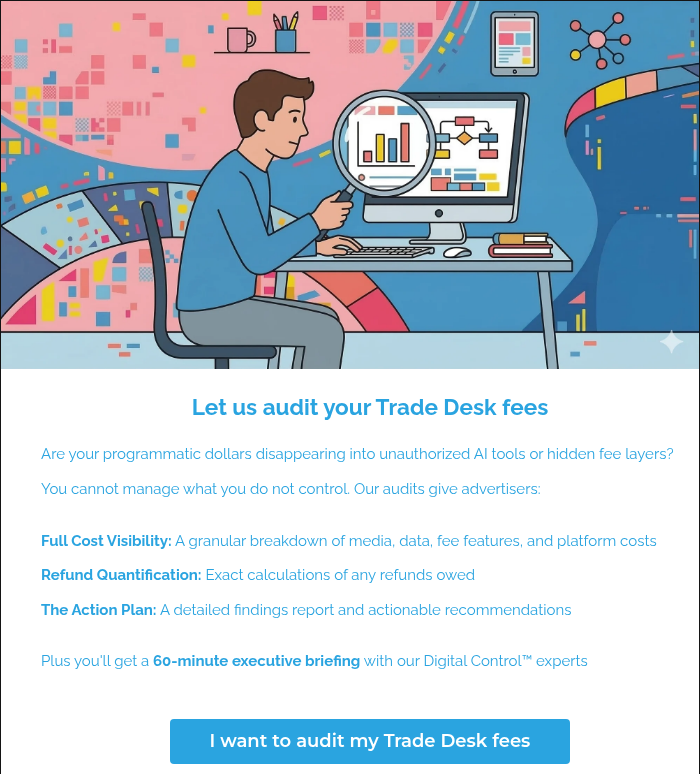
Um, one of the things that we do in our paid media audits f- uh, with, with a product called Digital Control, is that we audit, we audit fees. So we look at this stuff all the time. Um, that, but that's a wider product, which includes a specific kind of Trade Desk fee audit.
What we've decided to do because of this interest is to actually carve that out as a standalone piece of work. So if you do have a, uh, if you have any money that's going through Trade Desk, and you wanted to understand and get more visibility on fees, 'cause we can see it, then you can get it in, in con- in contact with us.
You can go to www.idcoms.com/digital-control. It's on the screen here. Or just go to idcoms.com. You can, you find that really super easy. Um, it's a fast-track audit to address this exact issue. Okay? It'll take a, a matter of weeks. We analyze a few things. We're looking at your master services agreement. Um, we're looking at adherence to contract. Identify exactly if there's any transparency gaps.
Um, most importantly, quantify the fees, and then if there's any refunds that we think that are maybe owed, um, you know, give you some exact actionable recommendations or wording that you need to try to trigger those, or we can help you do that.
Um, we always say you can't manage what you don't control, so that's why we call this Digital Control. We give advertisers control.
Um, okay. We're running out of time. 30-second wrap-up, David. What should we do now?
Um, just stand up. Take a, take an active part in this. And, uh, what has happened in the past has happened in the past, but be responsible for your clients, for your, for your brand's media investment by providing as much governance and visibility on that spend as you possibly can. And that will deliver disproportionate advantage in media for sure.
Great. And on that bombshell, as they say, we will leave you for now. Thank you for joining Media Snack Live. As always, check out the comments. Please go and subscribe so you can get our newsletter and our briefings, um, and we'll see you next week for more of this.
Okay, thanks mate. Bye.
See you next time.
Thanks for watching Media Snack Live. If you found it helpful and want to learn more, head to idcoms.com to get more tips, tools, and resources to help you get good at media. We'll see you next week.
Call to action: If you want a confidential conversation about your own 'gameplan' and options to protect your competitive advantage in media, get in touch with the ID Comms team today.




COMMENTS